
The Carry-On Only Method for a Two-Week Trip
Tripdash Team
July 7, 2026
A practical, no-nonsense system for fitting two full weeks into one carry-on bag. Covers capsule wardrobe logic, sink laundry tricks, what to cut first, and how carry-on size rules actually work across airlines.
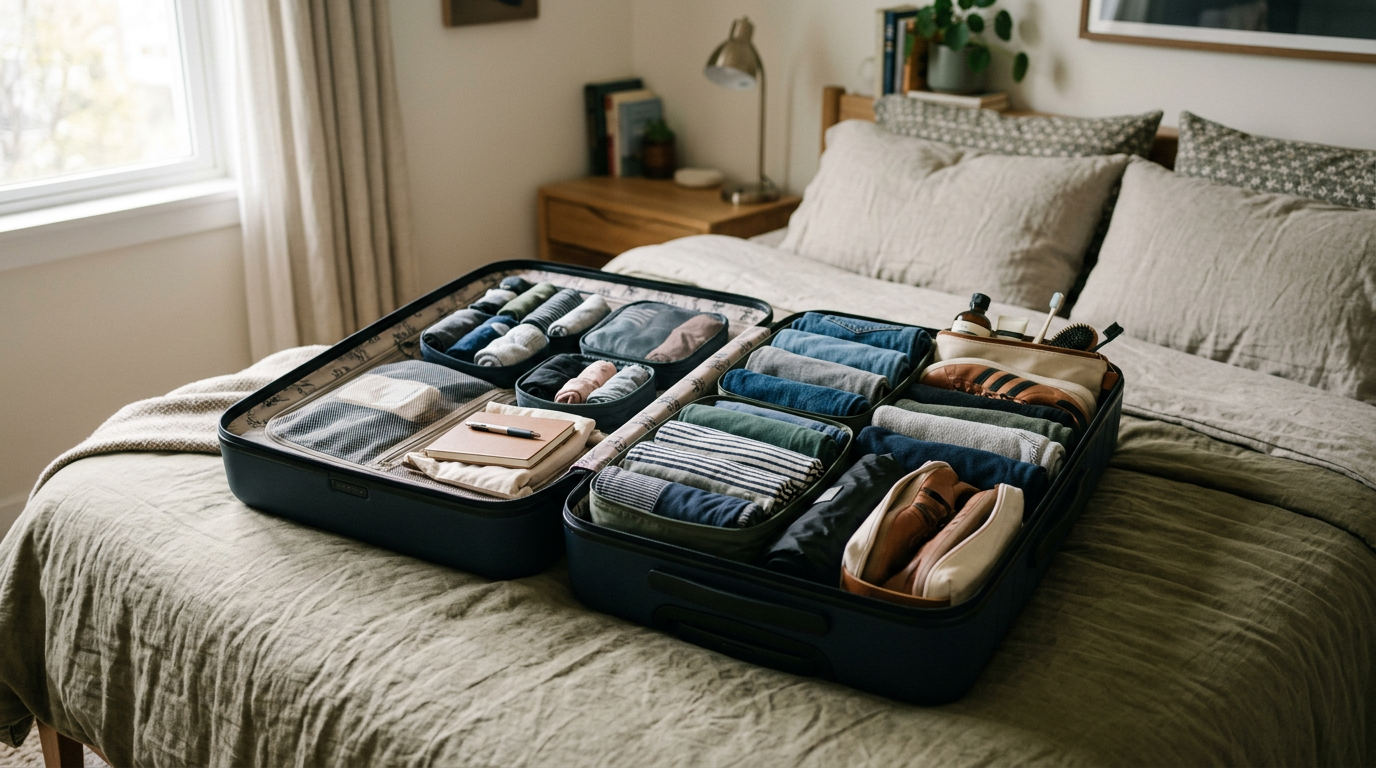
Two weeks in one bag sounds like a puzzle with no solution, until you realize the trick isn't fitting more into a carry-on. It's needing less. Most people who check a bag for a two-week trip are packing for fourteen imagined versions of themselves: the one who might go hiking, the one who might get invited somewhere fancy, the one who needs a backup for the backup. Cut that person out of the equation and a carry-on stops feeling like a constraint.
This isn't a minimalism lecture, it's a logistics problem, and logistics problems have mechanical solutions: a wardrobe that mixes and matches on purpose, a laundry routine that takes ten minutes a night, and a packing list that gets shorter every time you second-guess it. Here's how to actually do it.
Build a Capsule Wardrobe That Actually Works
The single biggest shift when you learn how to pack light is thinking in outfits, not items. A capsule wardrobe means every piece works with at least two or three other pieces. If a shirt only pairs with one pair of pants, it's dead weight for thirteen days out of fourteen.
Start with a color story: two neutrals (navy and gray, or black and khaki) plus one accent color, then build everything around them. This isn't about looking corporate, it's math. With a five-color wardrobe, every top works with every bottom, and you can build a new-looking outfit daily without repeating a combination for over a week.
Layering does the rest of the work. Instead of a heavy sweater for cold mornings and a separate jacket for evenings, pack a merino wool base layer, one mid-weight layer, and a packable shell. Merino earns its space because it resists odor across multiple wears, which matters when you're doing carry-on only travel and can't swap in a fresh shirt daily.
Fabric choice matters more than item count. Quick-dry synthetics and merino pack smaller, weigh less, and survive a sink wash overnight. Cotton is comfortable but it's the enemy of a two-week carry-on: bulky, slow to dry, and wrinkled by day four.
Once the wardrobe is set, a few categories are still the first to go if the bag runs over, since they're what people overpack out of anxiety rather than actual need. Shoes are the top offender: heavy, uncompressible, and disproportionate to how often you'll wear each pair. Two pairs is the realistic ceiling for most trips, one for walking and travel days, one for anything dressier or wet. "Just in case" items are the next cut: the rain jacket for a 10% chance of rain, the second belt, the outfit for a hypothetical event. If you can't name the specific day you'll use it, it's a candidate for staying home.
The Laundry-in-a-Sink System
You cannot pack fourteen days of clothes into a carry-on. You can pack five to seven days of clothes and wash as you go, which is the actual trick behind any real carry-on only packing for two weeks strategy.
The system is simple. Pack a small squeeze bottle of concentrated laundry soap and a flat rubber sink stopper, since hotel sinks often don't hold water well. Each night, wash whatever you wore: fill the sink, add soap, agitate for a minute, rinse until clear, then wring hard. Roll the item in a hotel towel and press with your body weight to pull out moisture, which cuts drying time. Hang it on a portable clothesline strung between two fixed points, or drape it near a window or fan.
Merino and synthetic blends dry overnight in most climates; cotton often doesn't. Somewhere humid, wash in the morning instead of at night so the item gets daylight hours to dry, and prioritize fast-drying items (underwear, socks, thin tees) on nights you're too tired to fuss with it.
Toiletry Rules for a Long Trip
Toiletries are where carry-on liquid rules collide with two-week reality, and the fix isn't bigger bottles, it's fewer categories.
Solid alternatives solve most of the volume problem: shampoo bars, solid sunscreen sticks, and solid deodorant skip liquid restrictions entirely and last longer per gram than their liquid equivalents. For anything that has to stay liquid, decant into small reusable silicone travel bottles sized to what you'll actually use in two weeks, not what fits in the bottle. Most people badly overestimate how much shampoo or lotion a two-week trip requires.
Assume you can buy things there. Toothpaste, sunscreen, bug spray, and basic medication exist in pharmacies almost everywhere, so there's little reason to pack a full-size backup of something replaceable for a couple of dollars at your destination. That single mindset shift, packing for day one and trusting you can restock, removes more weight than any gear upgrade.
Carry-On Size Limits and Personal Item Space
Carry-on dimensions and weight allowances vary by airline, and can even vary by fare class or route on the same airline, so treat any specific number you read online as a starting point to verify, not a rule to build a trip around. Budget carriers tend to run smaller and stricter than legacy international carriers, and some enforce carry-on weight limits in a way that others don't.
Check your specific airline's current policy before you pack, especially if you're flying multiple carriers on one itinerary, since a bag that's fine outbound can get flagged on a budget connection home. Beyond the wheeled carry-on, most airlines also allow a separate personal item that fits under the seat, and that space is worth more than people give it credit for.
| Bag type | General purpose | Typical contents |
|---|---|---|
| Carry-on (overhead bin) | Main clothing and gear storage | Capsule wardrobe, shoes, toiletry kit, packing cubes |
| Personal item (under seat) | Overflow and in-flight access | Electronics, documents, a layer for the plane, snacks |
| Packing cubes (inside carry-on) | Compression and organization | Grouped by outfit, not by item type |
Packing cubes aren't just for tidiness, they compress. Rolling clothes into cubes and pressing the air out gains real space over folding items loose into a bag, and that margin matters far more over two weeks than over a weekend.
The Two-Week Trip vs. the Weekend Bag
A weekend bag is forgiving. Forget something or run out of clean clothes and the trip is nearly over anyway. A two-week trip has no such safety net, which is why the strategy shifts from "pack enough" to "pack a system."
The core difference is that a weekend bag is inventory and a two-week carry-on is a process. You're not carrying fourteen days of solutions, you're carrying a small wardrobe plus a repeatable laundry routine plus a plan for buying anything you run out of. That reframing is what makes carry-on only travel realistic for longer trips, not just short ones.
It also changes how you think about backups. On a weekend trip, a backup outfit is reasonable insurance. On a two-week trip, backups multiply: a backup for week one becomes dead weight for the other thirteen days, exactly the kind of bulk that turns a carry-on into a checked bag. Trusting the system is what separates people who do this comfortably from people who fight their suitcase the whole trip.
The Actual Packing List
This is a realistic two-week, carry-on only list for a moderate climate, built around the capsule and laundry logic above. Adjust the specific pieces for climate, but keep the category counts roughly the same.
- 5 to 7 tops in coordinating colors, mixing merino wool and quick-dry synthetics
- 2 to 3 bottoms that each pair with every top (pants, shorts or a skirt, one dressier option)
- 1 lightweight layering system: base layer, mid layer, packable shell
- 7 days of underwear and socks, planned around washing every 5 to 7 days
- 2 pairs of shoes, one for walking and one for anything dressier or wet
- 1 toiletry kit built around solids and small decanted bottles, not full-size liquids
- A compact laundry kit: concentrated soap, a universal sink stopper, a small travel clothesline
- Packing cubes to compress and organize everything above by outfit, not by item type
That's the entire wardrobe for two weeks. It looks short on paper and it works in practice, because the system, not the volume, is doing the work.
Frequently asked questions
More from Tripdash

The Advisor Who Catches the Layover Marlow Missed
An illustrative case study of how a Tripdash advisor rebuilt a connection that Marlow's AI draft technically approved but shouldn't have. It's a close look at what human review of AI travel plans actually catches, and why the minimum connection time on a boarding pass is not the same thing as a safe one.

The Advisor Who Specializes in Solo Travel for Women
An illustrative look at why some Tripdash advisors build a niche reviewing trips for solo female travelers, and how that specialization plays out inside the queue.

The Difference Between an AI Draft and a Bookable Itinerary
Marlow can draft a trip in about a minute, but a draft is not the same thing as a trip you can pay for. Here is exactly what changes between the two, and why the gap matters.