
How Much Time to Actually Budget for Airport Connections
Tripdash Team
July 7, 2026
Minimum connection times are floors, not safe buffers. Here is realistic layover math for domestic and international transfers, and what actually eats your buffer.
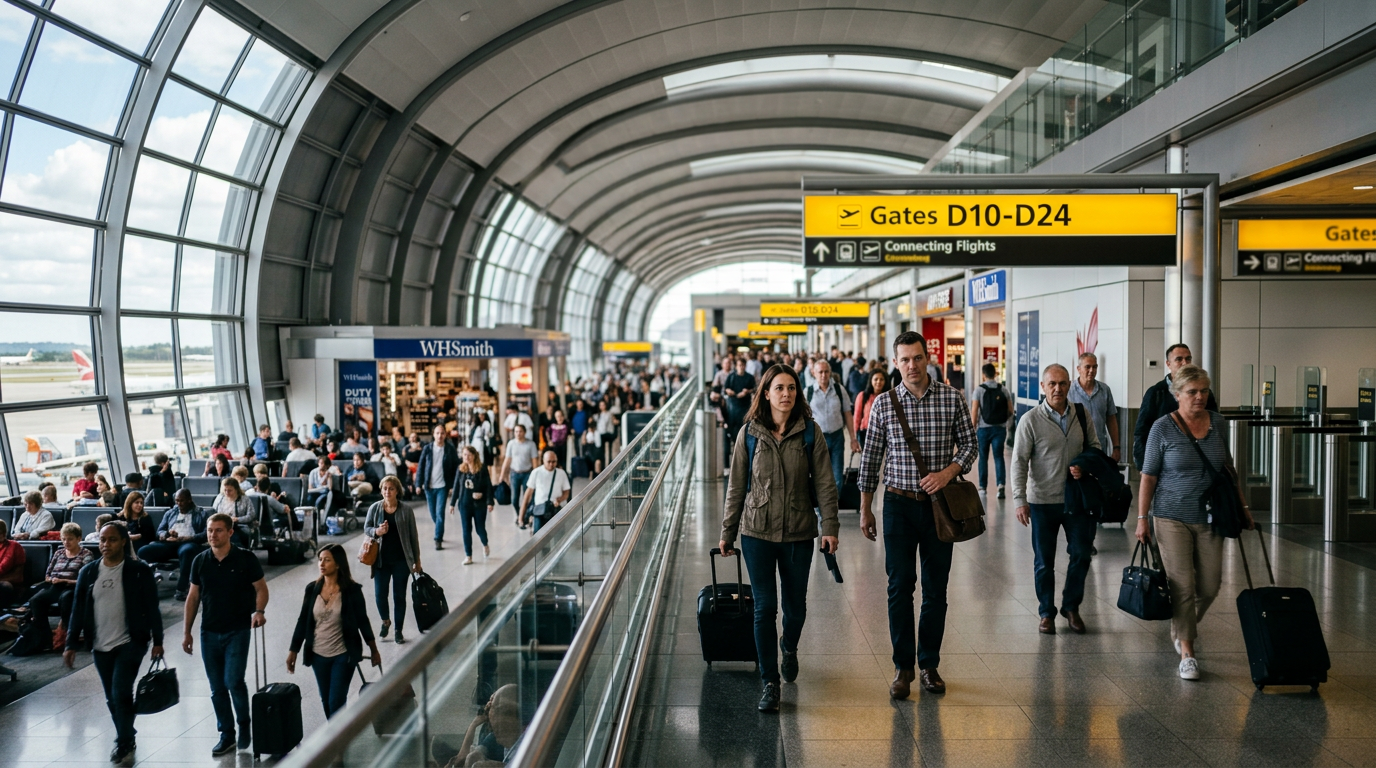
How Much Time to Actually Budget for Airport Connections
Every airline publishes a minimum connection time (MCT) for its hubs, and every booking engine will happily sell you an itinerary built right down to that minimum. The problem is that MCT is not a recommendation. It is a floor: the shortest amount of time the airport and airline believe is physically possible to move a bag and a body from one gate to another under normal conditions. It says nothing about a security line backed up because of a shift change, a gate that got moved to a different terminal after you checked in, or an immigration hall at a hub that only has six officers on duty for four wide-body arrivals at once.
Realistic layover math starts by treating the MCT as the number you never want to see on your own itinerary, not the number you plan around. This matters more the more international your trip gets, because the things that eat time, like re-clearing security or standing in a passport line, mostly do not exist on short domestic hops and mostly do exist on international ones.
Why the Minimum Connection Time Is Not a Safe Buffer
Airports set MCTs based on a fairly optimistic model: your inbound flight lands on time, your bag is offloaded quickly, the walk between gates is uncongested, and no additional screening is required. In practice, several of those assumptions fail on a normal day, not just a bad one. Airlines and global distribution systems will still let you book a connection at or near the published MCT, because technically it is allowed. That does not mean it is comfortable, and it definitely does not mean it will survive a fifteen-minute delay on the first leg.
A useful way to think about it is that MCT tells you the connection is legal. It does not tell you whether it is wise. Frequent flyers who work a given hub regularly learn to pad beyond MCT specifically because they have been burned by cutting it close, often more than once at the same airport before the lesson sticks.
What Actually Eats Your Buffer
The gap between an itinerary that technically clears the MCT and one that actually feels comfortable is filled by a predictable set of frictions. None of these show up on the MCT itself, which is exactly why relying on that number alone is risky.
- Terminal changes, which can mean a bus, train, or a genuinely long walk rather than a quick gate-to-gate stroll
- Re-clearing immigration and customs on international-to-domestic connections, since you are technically entering the country before continuing onward
- Re-screening through security if your connection routes through a non-sterile area, which is common at airports without full international transit corridors
- Passport control queues at hub airports that see multiple wide-body arrivals bunching up around the same time
- Bag re-check requirements, especially on separate tickets or when switching alliances or terminals
- Gate changes announced after landing that push your departure gate further from where you arrived
- Ground delays, holding patterns, or de-icing on the inbound leg that quietly consume your buffer before you have even landed
- Understaffing at passport control or security during off-peak hours, which can be slower than a busy but well-staffed period
Any one of these can turn a technically legal connection into a sprint through the terminal. Two or three of them stacking together is how people miss flights on paper-thin layovers.
Large Hubs Versus Small Airports
Airport size and layout change the math substantially, and not always in the direction people expect. A sprawling hub with multiple terminals connected by trains, the kind found at many major international gateways, can require twenty to thirty minutes just in transit time between arrival gate and departure gate, before accounting for any lines at all. A smaller regional airport with a single terminal might get you from one gate to another in under ten minutes on foot, but if it is your first port of entry into a country, a lightly staffed immigration desk can still turn that into a long wait with no way to speed it up.
The general pattern worth remembering is that hub complexity and border-control load matter more than raw distance. A physically compact airport with heavy immigration processing can eat more of your buffer than a large one with efficient, high-throughput border facilities. This is highly specific to each airport, so treating any single number as universal, even a well-reasoned one, is a mistake. The guidance below should be read as a general starting point, not a fixed rule for every airport.
General Guidance by Connection Type
The ranges below reflect commonly cited general guidance from frequent international travelers and travel advisors, not a guarantee for any specific airport, terminal, or date. Always check the actual MCT for your itinerary and add from there based on the factors above.
| Connection Type | General Recommended Buffer (beyond posted MCT) | Why |
|---|---|---|
| Domestic to domestic, same terminal | 20 to 40 minutes extra | Minimal friction, but gate changes and short delays still happen |
| Domestic to domestic, terminal change | 45 to 75 minutes extra | Transit time between terminals adds up even without extra screening |
| International to international, same alliance | 45 to 90 minutes extra | Usually no re-clearing needed, but hub congestion and long walks are common |
| International to domestic, first port of entry | 90 to 150 minutes extra | Immigration, customs, and possible bag re-check and re-screening all stack together |
| Small regional airport connections | 30 to 60 minutes extra | Fewer lines generally, but limited staffing can slow any single bottleneck significantly |
Treat these as starting ranges to adjust up or down based on the specific airport, time of day, and season, rather than as fixed universal numbers.
Planning Your Own Realistic Buffer
Instead of memorizing airport-by-airport numbers, it helps to ask a short set of questions before booking a tight connection. Is this an international-to-domestic connection, meaning you will clear immigration and customs before your next flight boards. Is the layover at a hub known for spread-out terminals or heavy passport control queues. Is your inbound flight on a route with a history of delays, whether from weather, air traffic congestion, or aircraft rotation issues. Are you connecting on separate tickets, which typically means no protection if you misconnect and your bags may need to be re-checked manually.
If the answer to more than one of these is yes, it is worth adding meaningfully more buffer than the posted MCT, and in some cases worth avoiding that specific routing altogether in favor of a longer layover or a different connecting airport. This is exactly the kind of judgment call that benefits from someone who has actually worked a given hub before. A Tripdash advisor who has routed travelers through a specific airport repeatedly can tell you, for example, that a particular terminal's passport control routinely runs long in the early evening, or that a quick-looking connection actually involves a train ride most travelers do not expect. That kind of specific, current knowledge is hard to replicate from a generic MCT lookup, and it is often the difference between a relaxed layover and a dead sprint to the gate.
Booking With the Buffer in Mind
When comparing itineraries, resist the urge to default to whichever option shows the shortest total travel time. A connection that looks thirty minutes faster on paper is not actually faster if it carries a meaningful chance of a misconnect, a missed bag, or an overnight delay while you wait for the next available flight. Building in a sensible buffer, informed by the connection type and the specific airport involved rather than a single rule of thumb, tends to produce trips that feel calmer and that actually arrive on the day you planned.
Frequently asked questions
More from Tripdash

The Advisor Who Catches the Layover Marlow Missed
An illustrative case study of how a Tripdash advisor rebuilt a connection that Marlow's AI draft technically approved but shouldn't have. It's a close look at what human review of AI travel plans actually catches, and why the minimum connection time on a boarding pass is not the same thing as a safe one.

The Advisor Who Specializes in Solo Travel for Women
An illustrative look at why some Tripdash advisors build a niche reviewing trips for solo female travelers, and how that specialization plays out inside the queue.

The Difference Between an AI Draft and a Bookable Itinerary
Marlow can draft a trip in about a minute, but a draft is not the same thing as a trip you can pay for. Here is exactly what changes between the two, and why the gap matters.