
Iceland in Winter vs. Iceland in Summer
Tripdash Team
July 7, 2026
Iceland in winter and Iceland in summer are practically two different destinations wearing the same name. This guide compares northern lights, ice caves, and short days against midnight sun, open highland roads, and puffins, so you can figure out which version of the country actually fits your trip.
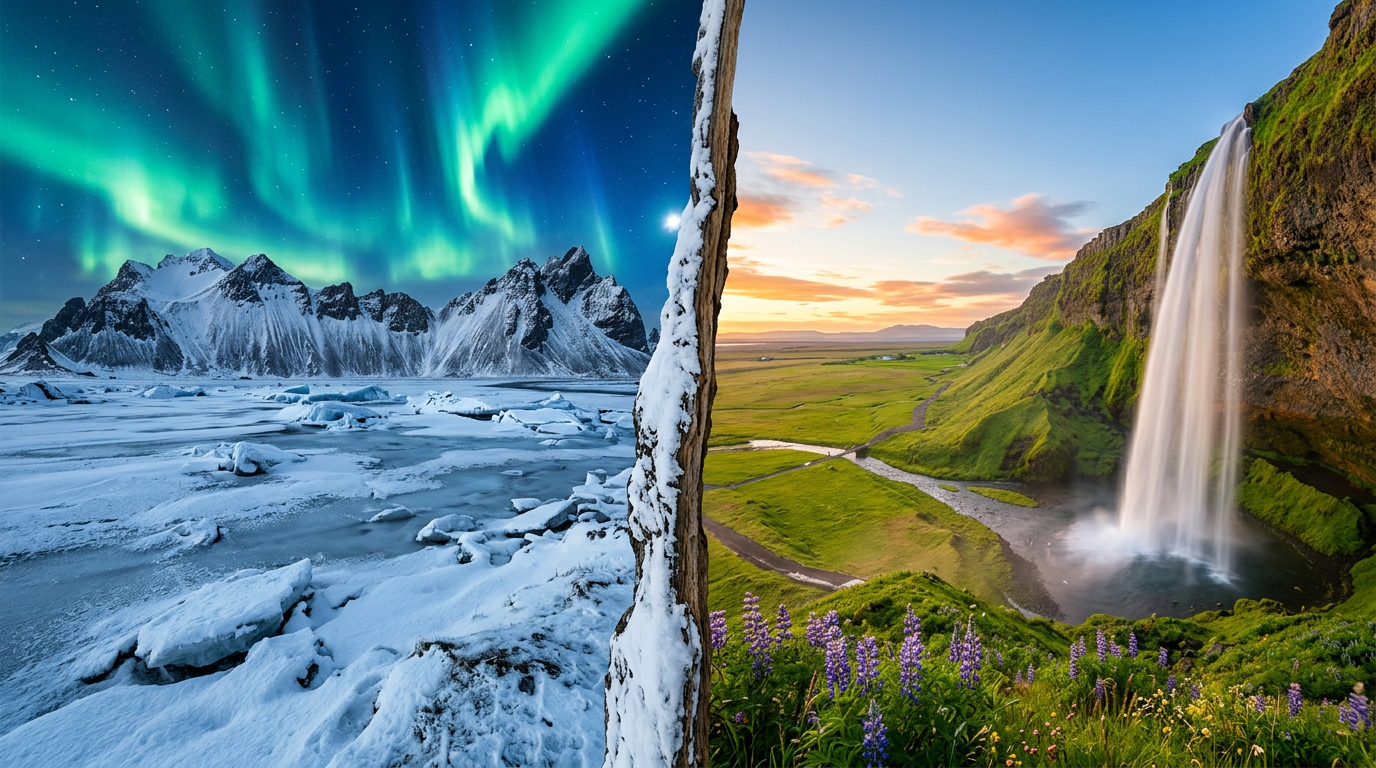
Iceland doesn't really have one identity. It has two, and they barely resemble each other. Fly in during February and you'll land in a country of blue-black afternoons, steam rising off snowfields, and a sky that sometimes turns green for no reason anyone can fully explain to a first-timer. Fly in during July and you'll find long gold evenings, gravel highland roads finally thawed open, and waterfalls so swollen with glacial melt you can feel the spray from the parking lot. Same island. Same ring road. Completely different trip.
If you're trying to figure out the best time to visit Iceland, the honest answer is that there isn't a single right answer, only a right answer for what you actually want. This guide breaks down both seasons plainly, including the parts that don't make it into the glossy brochures, so you can build a trip around your priorities instead of someone else's Instagram feed.
Winter Iceland: The Case for the Dark Months
Winter, roughly November through March, is when Iceland leans into its reputation as a moody, elemental place. The northern lights are the obvious draw, and they're a genuine reason to travel here in the off-season. Dark skies away from Reykjavik's light pollution give you a real shot at seeing them, though "real shot" is doing some work in that sentence. The aurora needs clear skies and solar activity to cooperate, and neither is guaranteed on any given night. Plan for several nights in the country, not one, if this is your main goal.
Ice caves are the other big winter-only activity. Under Vatnajokull and other glaciers, meltwater carves out chambers of blue ice that only become safely accessible once things freeze solid enough to enter, usually from November into March. These are strictly guided tours, and for good reason, since the caves shift and aren't stable year-round.
Winter also means shorter days, and this matters more than people expect. In December, you might get four to five hours of usable daylight, which compresses your sightseeing into a tight window and rules out some longer excursions entirely. Roads are the other honest caveat. The Ring Road can close after storms, the interior highland F-roads are shut completely, and a rental car in winter conditions demands real confidence in snow and ice driving, or a willingness to book guided tours instead of self-driving. Do not treat winter driving in Iceland as an afterthought.
On the upside, this is when you'll find lower prices on flights and hotels outside of the Christmas and New Year peak, plus noticeably thinner crowds at places like the Blue Lagoon or Golden Circle stops. There's also something genuinely appealing about the vibe: geothermal pools steaming against snow, candlelit cafes, and a country that feels wrapped up and quiet.
Summer Iceland: The Case for the Light Months
Summer, roughly June through August, flips the script entirely. This is midnight sun territory, meaning near-constant daylight in June and July that lets you cram in a waterfall, a glacier hike, and a late dinner all in the same "day" without ever losing the light. For travelers who want to maximize activity per day, this alone is a strong argument for summer.
It's also the only season when the highland F-roads open, usually from June into September depending on snowmelt, unlocking the interior: Landmannalaugar's rhyolite mountains, Thorsmork's valleys, and routes only a 4x4 can handle. If your Iceland trip planning includes hiking, backcountry camping, or the interior highlands specifically, summer is close to non-negotiable.
Wildlife-watching also peaks now. Puffins nest along coastal cliffs like Latrabjarg and the Westman Islands from roughly May through August, and whale-watching tours out of Husavik or Reykjavik run their fullest schedules. Waterfalls like Gullfoss, Skogafoss, and Seljalandsfoss are at their most dramatic thanks to glacial melt swelling the rivers.
The tradeoff is crowds and cost. July and early August are peak season, meaning higher prices on accommodation and rental cars, packed parking lots at the famous stops, and a need to book well ahead if you want specific guesthouses or tours. The northern lights are also a no-go in summer; the sky simply never gets dark enough.
Winter vs. Summer at a Glance
| Winter | Summer | |
|---|---|---|
| Daylight Hours | As little as 4-6 hours in December | Near 24-hour daylight in June-July |
| Key Activities | Northern lights, ice caves, geothermal pools | Hiking, puffins, waterfalls, highland driving |
| Road Access | Ring Road can close; F-roads shut | Full access including highland F-roads |
| Crowd Level | Light, except holiday weeks | Heavy, especially July-August |
| Price Level | Lower outside Christmas/New Year | Highest of the year in peak weeks |
How to Actually Decide
Start with the one thing you can't compromise on. If seeing the northern lights is the whole reason you're going, that decision alone rules out summer, no matter how appealing the midnight sun sounds. If hiking the highlands or seeing puffins up close is the goal, winter simply can't deliver that; the roads are closed and the birds have left. Everything else, budget, crowd tolerance, driving comfort, is a secondary filter once you've locked in the season your must-do activity requires.
Shoulder seasons are worth a mention here too. Late April into May and September into early October split the difference: more daylight than deep winter, fewer crowds and lower prices than peak summer, and a decent shot at aurora in the darker edges of those windows. If you're flexible and mainly want to avoid extremes, shoulder season is an underrated way to plan an Iceland trip.
This is also where getting a second set of eyes on your itinerary earns its keep. Iceland's weather and road conditions shift fast enough that a plan built purely from blog posts can fall apart once you're actually there. Tripdash's approach leans on this: Marlow, its AI planner, puts together a full day-by-day itinerary in under a minute based on your season and priorities, and then a human travel advisor reviews it, checks it against current road and weather realities, and adjusts before anything gets booked. For a destination as season-dependent as Iceland, that human check matters more than it would somewhere with a flatter climate curve.
What to Pack Differently
Packing for Iceland changes substantially depending on which version of the country you're visiting. Layering is the constant; the specifics are not.
- Winter: insulated waterproof boots with real tread, since ice and packed snow are a daily reality, not an occasional hazard.
- Winter: a heavier insulated jacket plus thermal base layers, since wind chill on the coast can make temperatures feel far colder than the forecast number.
- Winter: microspikes or ice cleats for your boots if you're doing any walking near waterfalls or glaciers.
- Summer: a solid rain shell rather than a heavy coat, since summer weather is more about wind and drizzle than cold.
- Summer: an eye mask, since a bright 2 a.m. sky will otherwise wreck your sleep schedule.
- Both seasons: a swimsuit for geothermal pools, which are a year-round activity regardless of season.
- Both seasons: layers you can shed and add quickly, since Iceland's weather can shift within a single afternoon no matter the month.
Booking Windows and Practical Timing
If northern lights are the priority, aim for the darkest, clearest stretches, typically late September through March, and build in at least four or five nights to improve your odds. If you're chasing the highlands and long hiking days, June through August is your window, and you'll want to book accommodation and highland tours months ahead since capacity is limited and demand is high. For a first trip that wants a taste of both without going all-in on either extreme, May or September gives you a reasonable middle ground: usable daylight, open (or nearly open) roads, and prices that haven't hit their peak.
Whichever season you land on, build slack into the itinerary. Iceland's weather doesn't care about your schedule, and the travelers who have the best time are usually the ones who planned a flexible route rather than a rigid one.
Frequently asked questions
More from Tripdash

The Advisor Who Catches the Layover Marlow Missed
An illustrative case study of how a Tripdash advisor rebuilt a connection that Marlow's AI draft technically approved but shouldn't have. It's a close look at what human review of AI travel plans actually catches, and why the minimum connection time on a boarding pass is not the same thing as a safe one.
The Advisor Who Specializes in Solo Travel for Women
An illustrative look at why some Tripdash advisors build a niche reviewing trips for solo female travelers, and how that specialization plays out inside the queue.

The Difference Between an AI Draft and a Bookable Itinerary
Marlow can draft a trip in about a minute, but a draft is not the same thing as a trip you can pay for. Here is exactly what changes between the two, and why the gap matters.