
What a Draft Itinerary Looks Like Before Your Advisor Touches It
Tripdash Team
July 7, 2026
A sample walkthrough of what Marlow's first-pass draft actually contains, from flight tradeoffs to a day-by-day flow to the details flagged for your advisor to confirm.
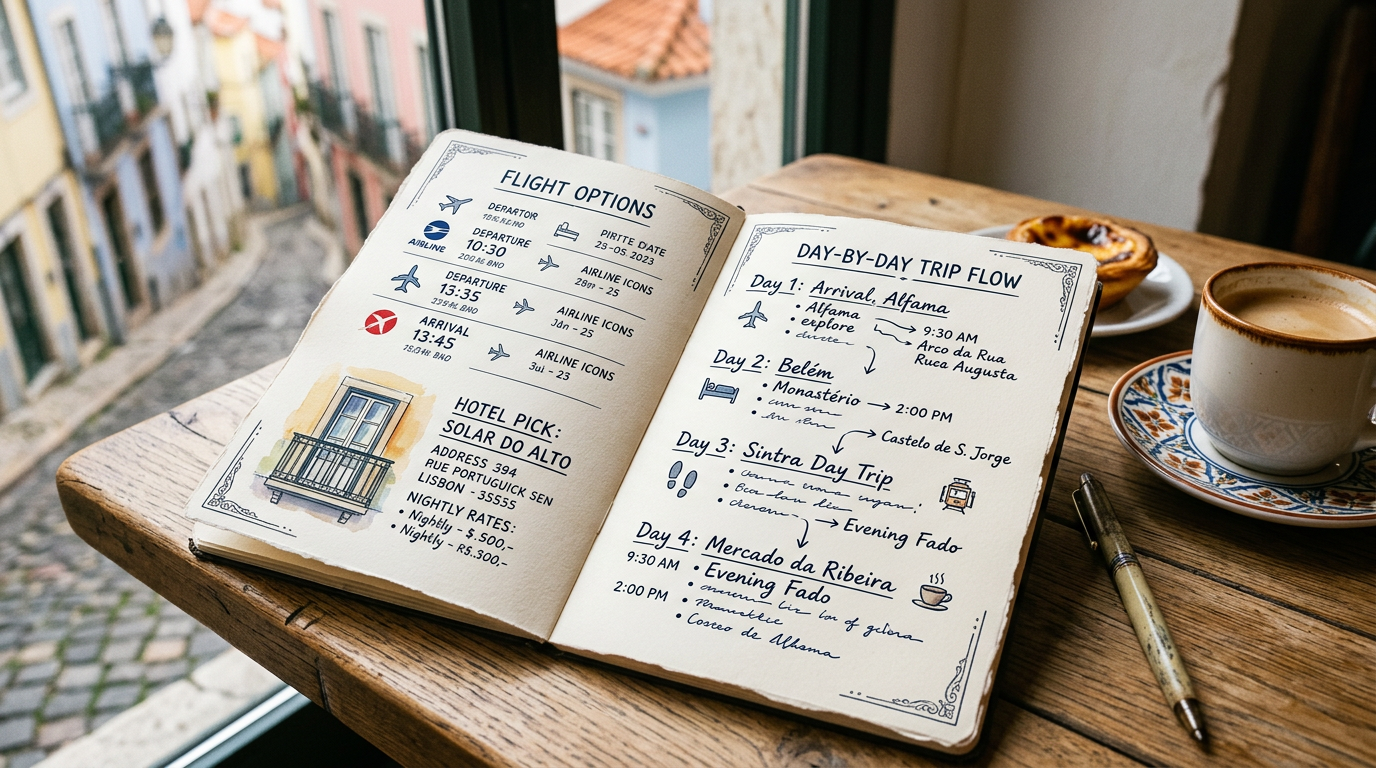
Ask Marlow for a trip and something will land in your inbox in about a minute. That speed raises an obvious question: what does an AI generated itinerary actually look like before a human advisor gets involved? Is it a polished plan ready to book, or a rough sketch that needs a lot of cleanup?
The honest answer is somewhere in between, and the shape of that answer matters more than the speed does. Below is a sample walkthrough of a first-pass draft: a hypothetical 5-day Lisbon trip for two travelers in October. Nobody actually took this trip. It exists here to show the structure Marlow produces, the level of detail it includes, and the places where it deliberately says "an advisor should check this" instead of guessing.
The First Pass: What Marlow Actually Builds
When a traveler submits a request, whether through a quick form or a short back-and-forth about dates and vibe, Marlow assembles a draft with several distinct parts. It is not a single paragraph of prose. It is closer to a working document, broken into sections an advisor can scan and edit section by section rather than rewriting from scratch.
For our sample Lisbon trip, the request was simple: two adults, five nights in early October, mid-range budget, interest in food and old neighborhoods, one day trip out of the city. Here is what came back.
Flight options. Marlow doesn't pick one flight and call it done. It surfaces two or three reasonable combinations with the tradeoffs stated plainly: a nonstop that lands mid-afternoon and costs more, versus a one-stop that saves money but arrives after 9pm and eats into the first evening. For this sample, the draft flagged that the cheaper option's connection window was tight, only 55 minutes, and suggested the advisor confirm whether that particular connection has a history of gate changes before presenting it to the traveler.
A hotel pick, labeled by category. Rather than naming a single hotel as "the answer," the draft names one primary pick and tags it clearly: boutique, 3-star-plus, walkable to the neighborhoods the traveler mentioned. In this sample, it chose a small hotel in Alfama with a note that the rooms are compact, common for the area's older buildings, and that a traveler prioritizing space over location might prefer an alternative in Chiado instead. That alternative was listed too, not buried.
A day-by-day flow, which is the heart of the draft. This is where pacing gets decided: how much walking, how many timed reservations, whether there's breathing room built in after a travel day. It's also where Marlow is most useful and most in need of a second look, since pacing is a judgment call, not a lookup.
Flags for anything uncertain. This is the part that separates a genuinely useful draft from a generic list of attractions. Anywhere the draft is guessing, extrapolating, or working from incomplete information, it says so instead of presenting a guess as fact.
Sample Day-by-Day Structure
Here's how the middle stretch of the illustrative Lisbon draft looked, condensed into the format an advisor actually reviews it in.
| Day | Morning | Afternoon | Evening | Flag |
|---|---|---|---|---|
| 1 | Arrival, check-in | Short walk in Alfama, no fixed plans | Dinner near hotel, no reservation | None |
| 2 | Belem Tower and monastery | Lunch, then free time | Fado dinner show | Reservation needed 2+ weeks ahead |
| 3 | Day trip to Sintra | Sintra palaces continued | Return to Lisbon, rest | Train timing not yet confirmed |
| 4 | Free morning | Cooking class | Free evening | Class assumes basic mobility, confirm with traveler |
| 5 | Pack, late checkout | Departure transfer | - | Transfer time depends on final flight |
Notice what the table does not do. It doesn't pretend the Sintra train schedule is locked in, and it doesn't assume every traveler wants a hands-on cooking class without checking first. Those flags exist precisely so the advisor addresses them before anything gets confirmed, not after.
Why the Draft Includes Uncertainty on Purpose
A draft that hides its own gaps is more dangerous than one that shows them. If Marlow silently picked a fado dinner without noting the booking lead time, the advisor might not catch it until it's too late to secure a table. The flagging isn't a limitation bolted on as an apology. It's a deliberate part of the output, because the entire point of the draft is that a person reviews it before anything goes near a booking confirmation.
This matters for a simple reason: travel involves real constraints that shift by the day. Train timetables change seasonally. Restaurants update their reservation policies. A traveler's stated interest in a "cooking class" might mean something different once an advisor actually asks a follow-up question. A first-pass draft can propose a reasonable structure, but it can't verify everything in real time, and it shouldn't pretend to.
What an Advisor Actually Changes
Given a draft like the sample above, an advisor's work isn't rebuilding it. It's targeted refinement, usually touching a handful of specific things:
- Swapping the tight-connection flight for the nonstop once the traveler confirms budget flexibility, or vice versa
- Calling ahead or checking real-time availability for the fado dinner and locking a reservation
- Confirming the Sintra train schedule for the actual travel dates rather than a general assumption
- Asking the traveler directly whether the cooking class fits their interests, then swapping it for a market visit or a different activity if not
- Adjusting hotel choice if the traveler responds that they'd rather have more room than location
- Tightening or loosening the pacing based on how the traveler describes their travel style
None of these are dramatic overhauls. They're the kind of judgment calls that come from actually knowing the traveler, the season, and the current state of a reservation book, which is exactly what a first pass isn't positioned to know on its own.
Reading a Draft Element Versus What It Shows
The pattern above repeats across every section of the draft: options plus tradeoffs, never a single unexplained answer. Flight options show two or three combinations with cost and time tradeoffs stated directly. The hotel pick shows category and location logic, plus a named alternative. The day-by-day flow shows pacing and sequencing rather than just a list of sights. The flags show where a human needs to step in before anything gets confirmed. Each piece is designed to be legible at a glance, because an advisor reviewing several drafts a day doesn't have time to reverse-engineer the reasoning behind a recommendation.
What This Means If You're Considering Tripdash
If you're wondering what to expect from your own request, the honest expectation is a structured starting point, not a finished plan. You'll see flight options with their tradeoffs spelled out, a hotel recommendation with a clear category and a stated alternative, a day-by-day flow that's paced reasonably but not locked in stone, and explicit notes on anything that still needs confirming. Your advisor takes that draft and turns it into something bookable, using the flags as a checklist rather than starting from a blank page.
The value of the first pass isn't that it eliminates human judgment. It's that it gives a human something concrete to react to within about a minute of the request going in, instead of a blank page and a long wait.
Frequently asked questions
More from Tripdash

The Advisor Who Catches the Layover Marlow Missed
An illustrative case study of how a Tripdash advisor rebuilt a connection that Marlow's AI draft technically approved but shouldn't have. It's a close look at what human review of AI travel plans actually catches, and why the minimum connection time on a boarding pass is not the same thing as a safe one.

The Advisor Who Specializes in Solo Travel for Women
An illustrative look at why some Tripdash advisors build a niche reviewing trips for solo female travelers, and how that specialization plays out inside the queue.

The Difference Between an AI Draft and a Bookable Itinerary
Marlow can draft a trip in about a minute, but a draft is not the same thing as a trip you can pay for. Here is exactly what changes between the two, and why the gap matters.